Origins
Where did the 3 sets of 10 routine come from?
3 sets of 10 began as a 1940s rehab protocol for injured soldiers. In the original, only the last set was heavy. Here is the history, and what still holds.
Stjepan Buljat
Reviewed by Stjepan Buljat · sources checked November 19, 2026
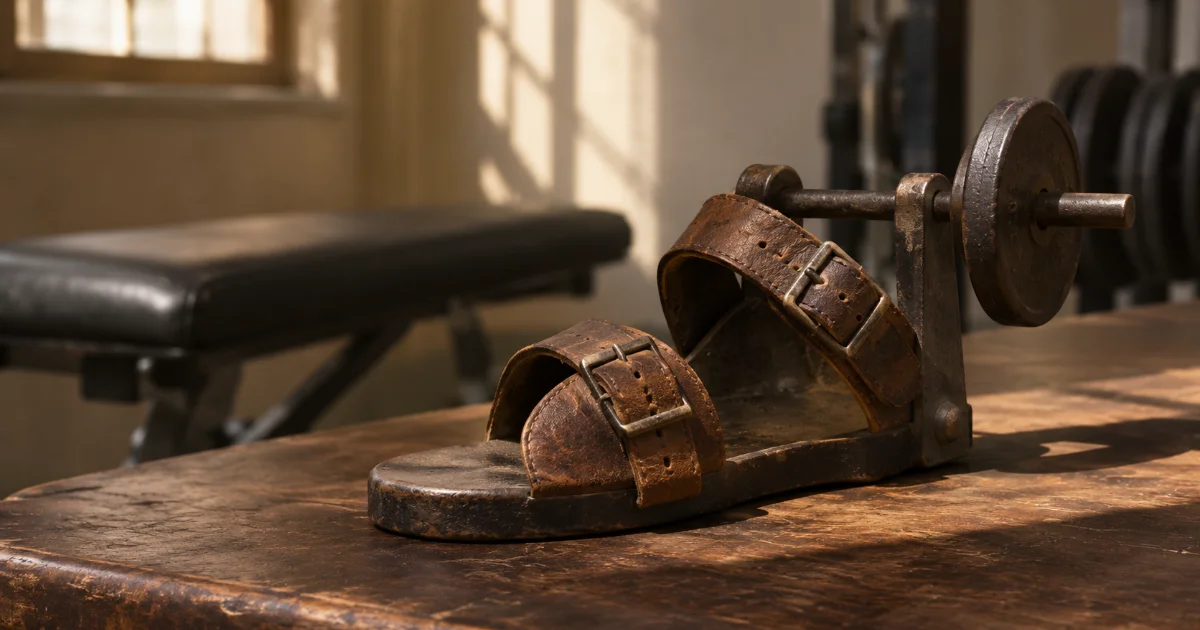
Three sets of ten comes from Thomas DeLorme, a US Army doctor who used weights to rehabilitate injured soldiers at Gardiner General Hospital in Chicago during the Second World War. His early publications recommended seven to ten sets of ten repetitions. By 1948, with Arthur Watkins at Massachusetts General Hospital, he had cut it to three sets of ten: the first at half of the patient's ten-rep maximum, the second at three quarters, and only the third at the full weight. From physical therapy it spread into gyms and sport. One detail sets the original apart: only one of the three sets used the full ten-rep maximum.
| DeLorme, 1948 | Oxford technique | Example: 3×10 with one load | |
|---|---|---|---|
| Set 1 | 50% of the 10-rep max | The full 10-rep max | Working weight |
| Set 2 | 75% | Lighter | Same weight |
| Set 3 | 100%, the only all-out set | Lighter again | Same weight |
| Example, leg extension with a 40 kg 10-rep max | 20 kg, 30 kg, 40 kg | 40 kg first, then less | One load for all three sets, light enough that the third set still reaches ten reps |
| When the load goes up | When the last set passes ten reps | Set from the 10-rep max, re-tested weekly in the 2003 trial | Not part of the name |
The first column follows DeLorme and Watkins’ original 1948 paper, page 264. The second is the reversed version a 2003 trial compared it with. The third is an example that uses the same load for all three sets.
Seventy reps and a pair of iron boots
The historians Jason Shurley, Jan Todd and Terry Todd begin their account with a knee. Private Easley, a farmer from Lake Charles, Louisiana, had ruptured the anterior cruciate and medial collateral ligaments in a parachute jump. After more than six months of standard rehabilitation at Gardiner, his doctors told him he would wear a brace for the rest of his life.
Rehabilitation at the time meant rest, heat and many repetitions against little or no resistance. One physical therapy text of the period warned that care should be taken "not to overtire the weakened muscles." DeLorme thought the opposite. He had lifted since his teens, after rheumatic fever had kept him in bed for four months, and he suspected that what slowed many injured men was simply a lack of strength.
So he brought his own iron boots from home. Easley did leg extensions with the boots and leg curls on improvised pulleys, seven sets of ten at the most weight he could handle, and added weight as he mastered it. Seventy reps per exercise. Within a month his quadriceps had grown and the swelling and pain were gone. He took off the brace. For "all activities, even 'jitterbugging,'" DeLorme later wrote, "the knee was normal."
DeLorme then took twenty men who had finished the usual program without recovering, and all twenty gained strength and joint function. He described the work in the Journal of Bone and Joint Surgery in 1945, under the name "heavy-resistance exercises." By his 1946 paper he had treated more than 300 patients and explained how to find a patient's one-rep and ten-rep maximum.
Why seven sets became three
In 1948 DeLorme and Watkins published "Technics of Progressive Resistance Exercise." Two things changed in it.
The name went first. DeLorme dropped "heavy resistance" because, he wrote, the term "bears false implications" and suggests "only great poundages are used." The new name, progressive resistance exercise, came from his wife, Eleanor, after he complained that physicians were uncomfortable recommending "heavy weightlifting" to patients.
Then the volume. DeLorme and Watkins had been experimenting with fewer sets, because fewer repetitions "permit exercise with heavier muscle loads, thereby yielding greater and more rapid muscle hypertrophy." The new model was three sets of ten at 50%, 75% and 100% of the ten-rep maximum. The two lighter sets warmed the muscle up before the one set that asked for maximum effort. Once a patient could do more than ten reps on that last set, the weight went up.
The paper was written for doctors treating polio. The three-sets-of-ten model, the historians write, "quickly moved beyond rehabilitation and became a 'norm' for fitness and sport training as well."
How a clinic's protocol became the gym default
The 1951 book by DeLorme and Watkins, Progressive Resistance Exercise, put strength training in front of thousands of American doctors, therapists and physical educators, with the blessing of some of the most respected physicians in the country. A 2012 review in the Journal of Strength and Conditioning Research says the method was "quickly adopted as the standard in both military and civilian physical therapy programs."
The weightlifters had a point about credit. Exercise physiologist Phil Rasch wrote at the time that DeLorme was praised for "the exact dogma" that weight-training pioneers such as Calvert, Jowett and Hoffman had preached for a quarter of a century. Yet at least one of those pioneers gave no set count. The same year DeLorme's book came out, Bob Hoffman's York course told bodybuilders to work up from 6 to 12 or 15 reps, add weight and start again, and said nothing about how many sets to do.
Seen this way, the lifters gave medicine the idea of heavy, progressive training, and medicine handed the gym a number. The number travelled better than the rule behind it.
What the popular story gets wrong
"Research found three sets of ten to be optimal." Not in the historians' account. DeLorme and Watkins arrived at three sets by trying fewer sets with their patients. Nothing in the account describes a study that compared two sets against three or five.
"All three sets are the same weight." In DeLorme's version, two of the three sets were preparation. A coach who writes 3×10 at one load is prescribing something closer to three working sets, which is a different dose.
"DeLorme invented strength training." He made it acceptable to medicine and measured it in patients. The lifting itself, and much of the logic, came from the weightlifting magazines he read as a sick teenager.
Does it still hold up?
Only part of it has been tested head to head. In a 2003 randomized trial, 50 people did three sets of ten knee extensions three times a week for nine weeks, with the ten-rep maximum measured every week. One group added weight across the sets, as DeLorme did. The other started at the ten-rep maximum and took weight off, the Oxford technique. Both groups gained strength, and neither did clearly better than the other. The trial had no group doing three sets at one load, and because both groups progressed the same way, it cannot say whether progression matters more than the order of the sets.
The 2026 position stand of the American College of Sports Medicine puts the number in context. Strength improved most with heavier loads (at least 80% of a one-rep max), two to three sets per exercise and at least two sessions a week. Muscle grew more with higher volume, at least ten sets per muscle group a week. Training to failure was not needed: stopping two or three reps short was enough effort. And the authors wrote that getting people to do resistance training at all matters more than "conforming to specific" prescriptions.
The label 3×10 does not say how heavy the sets are or how many sets a muscle gets in a week, so on its own it cannot be checked against these numbers. As a starting structure it is reasonable. It is not a finding.
DeLorme's own evidence has a limit: his patients were injured soldiers and, later, polio patients, and his early reports described his own patients, not people randomly assigned to different programs. The protocol did well with them. Whether it suits a 55-year-old returning to the gym or a trained lifter is a question for today's research, not for the 1948 paper.
Write down when to increase the load
The useful part of DeLorme's system is not the 3 or the 10. It is the order of operations: find the weight the athlete can lift ten times, make one set hard, and raise the load when that set goes past ten.
"3×10" tells the athlete what to do today. A rule such as "When the last set passes ten, add 2.5 kg" also tells them what comes next. Pick the increment to suit the exercise and the athlete.
Write the progression rule beside the sets and reps.
If you use the same load for all three sets, pick it for the third set, not the first. Say the target is two or three reps in reserve, the effort the ACSM calls enough: then the last set of the Thursday leg day should end there, and the first two will feel easier.
With the load and reps written down, it is easy to see whether the agreed progression rule has been met. In the Diby app, athletes log each set's real weight and reps against what was prescribed, and the coach sees the session set by set afterwards. Whether the last set reached eleven reps is on the screen, not in a memory of last Thursday. Get the Diby app.
For what to do between those sets, read how to plan rest between sets. For a lifter who wants to know when a number counts as strong, read how to use strength standards with clients, and for why the plan matters less than how it reaches the athlete, the real problem isn't your programming.
In the protocol described by the historians, DeLorme picked a weight a patient could lift ten times and increased it when the patient could do more.
Frequently asked questions
- Who invented 3 sets of 10 reps?
- Thomas DeLorme, a US Army physician, with Arthur Watkins at Massachusetts General Hospital. DeLorme’s early publications recommended seven to ten sets of ten; the 1948 paper described three sets with increasing loads. Their 1951 book spread the method through physical therapy and into gyms.
- What is the DeLorme method?
- Three sets of ten reps with rising weight: 50%, 75% and 100% of the heaviest weight the person can lift ten times. The first two sets prepare the muscle and only the third is an all-out effort. When the last set goes past ten reps, the weight goes up.
- Is 3 sets of 10 the best way to build muscle?
- It is a reasonable starting structure, not a proven best. The 2026 ACSM position stand found strength gains with two to three sets per exercise and more muscle growth with at least ten sets per muscle group a week. It also found that different programs can work when the effort is high enough.
- What is the difference between the DeLorme and Oxford techniques?
- DeLorme builds up to the ten-rep maximum across the three sets, and the Oxford technique starts at it and takes weight off. In a 2003 randomized trial with 50 people doing knee extensions for nine weeks, both groups gained strength by similar amounts. The order of the sets made no significant difference.
- Should every set in 3 sets of 10 be to failure?
- No. In DeLorme's version only the last set was hard. The 2026 ACSM position stand found that training to failure does not add strength or size, and that stopping two or three reps short is enough effort.
Sources
- Shurley J, Todd J, Todd T. Science from Strength: Thomas L. DeLorme and the Medical Acceptance of Progressive Resistance Exercise. Iron Game History 12(4) & 13(1), August 2014 (full text: PDF at starkcenter.org/igh/igh-v12/igh-v12-n4-v13-n1/igh1204-1301p68.pdf, a scan read by OCR)
- Todd JS, Shurley JP, Todd TC. Thomas L. DeLorme and the science of progressive resistance exercise. Journal of Strength and Conditioning Research 26(11):2913-2923, 2012 (abstract)
- Fish DE, Krabak BJ, Johnson-Greene D, DeLateur BJ. Optimal resistance training: comparison of DeLorme with Oxford techniques. American Journal of Physical Medicine & Rehabilitation 82(12):903-909, 2003 (abstract)
- Currier BS et al. American College of Sports Medicine Position Stand. Resistance Training Prescription for Muscle Function, Hypertrophy, and Physical Performance in Healthy Adults: An Overview of Reviews. Medicine & Science in Sports & Exercise, 2026
- DeLorme TL, Watkins AL. Technics of Progressive Resistance Exercise. Archives of Physical Medicine. 1948;29(5):263–273. Original paper, pp. 263–264 read in full.